
Casualties: Unknown prosthetics by tier
Scroll the table for more columns.
| Tier | Fitting INT / strength | Repair examples |
|---|---|---|
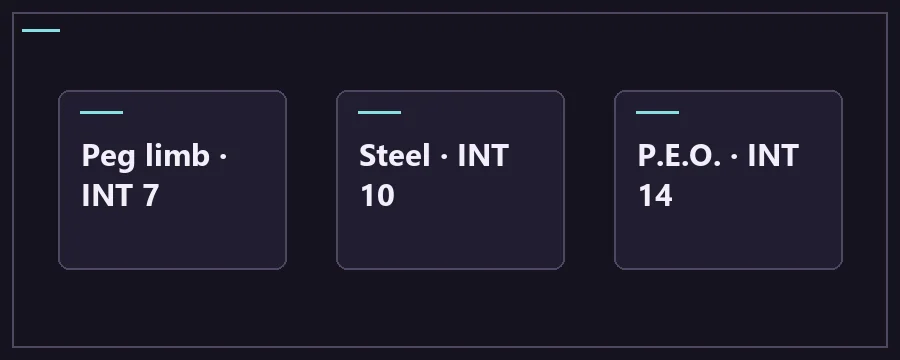
| Peg limb | 7 / 45% | Wood scraps |
| Steel prosthesis | 10 / 100% | Scrap metal or scrap panel |
| P.E.O. limb | 14 / 125% | Processed titanium, including sheets |
Fit and confirm the replacement
Once the limb is fully missing, move the replacement onto the corresponding torso region in the health panel. Low INT can cause fitting to fail and injure the character. Check that the limb appears on the body diagram and that it moves normally before leaving safety.
Fix a bend before patching damage
Use a wrench on a bent prosthesis first. Place the matching repair material over a cracked or low-integrity limb to open the repair interaction. Raw ilmenite cannot repair a P.E.O. limb. The 1.0.2 notes describe a fix for a leftover item at 1% condition when repairing with titanium sheets.
Tell fitting failure from damage after installation
Start by inspecting the diagram. If an upper arm or thigh is still attached, a missing hand or foot leaves that mounting position occupied. When the entire extremity is missing, hover the fitting item over the corresponding torso region. Check your current INT before attempting it. The community source describes failed fits below the reliable threshold adding pain, bleeding and damage to the targeted body part.
Once fitted, a prosthetic part has a different set of readings from flesh. The community reference tracks its integrity under muscle health. It does not bleed or get infected like a biological limb. An injury to the rest of the character can still cause those warnings, so check which body part is responsible before using the contents of your bag.
Carry repair stock for the tier you are actually using. A metal scrap for Steel has a different role from a titanium sheet for P.E.O. Keep a suitable wrench accessible if you see a bent part. Fix the bend before attempting an ordinary repair. Confirm the limb moves again before leaving the shelf, since an unresolved problem may only become obvious on the next climb.
Keep the fitting and repair checks separate when you are planning supplies. If you have a spare limb in your bag, note both the INT needed to attach it and what you could use to maintain it later. If the part is already installed, inspect the current integrity before picking up a second limb. A repair may get you operational with the resources you can replace on that layer.
Compare lower-cost materials with where you are about to travel. Wood scraps for a Peg limb and metal scrap for Steel can be useful reserves when they are available. A P.E.O. limb calls for processed stock, so check both what you are carrying and which forms your recipes expect. Leave enough space for a wrench or the right repair material if this replacement is essential to your route.
After a repair, compare the part before and after your action. If you still see a warning, check whether the tool addressed only a bend and you still need to deal with damage. If everything looks good on the diagram, test the next small movement from a shelf. That test is worth doing before attempting a drop that depends on you being able to climb back.
If the removed part is gone, check the target connection and whether you now have the matching replacement. The source describes different outcomes for fitting versus removing an installed limb. Keep the part you intend to use in reach and avoid spending repair material on an unrelated warning while you are reorganizing the kit.
Scroll the table for more columns.
| Symptom | First check |
|---|---|
| The new part will not attach | Check the entire limb is missing and compare your current INT against the tier. |
| Bent prosthesis warning | Use a wrench to address the bend before applying the tier’s repair material. |
| Critical material loss | Inspect integrity and apply an appropriate material to the affected part. |
| Loose screws | Check shrapnel or critical material loss. Continuing to move can cause more damage. |
Prosthetic limb questions
Can I replace only a missing foot or hand?
The replacement mounts where the whole limb is missing. A lower segment can be absent while the upper connection remains occupied. Use the health panel to confirm the state of the entire extremity before trying to attach a part. If you only need to address an injury to an existing part, read the injury instead of treating it as an installation problem.
Which INT applies to fitting the limb?
The community reference lists reliable fitting at INT 7 for Peg, 10 for Steel and 14 for P.E.O. These are fitting figures. Crafting the item is a separate recipe decision and can ask for tools and other quantities. Compare your current INT and the item you are trying to mount before spending resources on a failed attempt.
Is the strongest limb always the best to take?
Think about when you can fit and maintain it. Peg is less durable but needs lower fitting INT and uses cheaper repair material. P.E.O. has higher strength and asks for more INT and processed titanium. Keep a part that gets you moving with resources you can replace on the route, especially if you are still far from the material needed for the stronger one.
What causes a prosthetic part to become unusable?
A bend can disable use until you fix it with a wrench. Critical loss of material can also leave the part unusable or prone to breaking. Read the exact tooltip and look at its integrity, then check the affected part after the repair. If movement still feels limited, look for a second damage state before heading onto another rope.
Can raw ilmenite repair P.E.O.?
Use the corresponding processed titanium. The reference describes sheets as an accepted repair material and raw ore as unsuitable. Check what the repair prompt accepts before converting your entire supply. Titanium rods and sheets also serve crafting recipes, so reserve what you will need if the limb is central to your ability to travel.
What changed for titanium sheets in 1.0.2?
The developer fixed a case where repairing a P.E.O. limb with titanium sheets left a 1% item. The patch note refers to the leftover material after the repair. You still need to bring a valid processed material and address any bend first. Look at the health panel to confirm the state of the limb after the interaction.
Can a prosthetic limb bleed or get infected?
The prosthesis itself does not suffer bleeding or infection like a biological limb. You can still see those warnings from the torso or another limb, and failed fitting can injure the body where you tried to attach it. Compare the warning with the diagram and the actual area affected before picking a treatment or a piece of metal.
How should I plan around a damaged leg before the next layer?
Find a stable place and inspect whether it is bent, broken or losing material. Do the repair that matches its state, then test movement. If the part still cannot be used, look for a safer route back to supplies. Holding spare material you can actually apply matters more than carrying unrelated metal that fills a bag.